We’ve all been part of teams at some point. I wonder if, like me, you’ve had moments where you felt like pulling your hair out—frustrated by misalignment or unspoken expectations. And I wonder if you’ve also experienced teams that brought out the best in you, where trust and shared purpose made working together feel effortless.
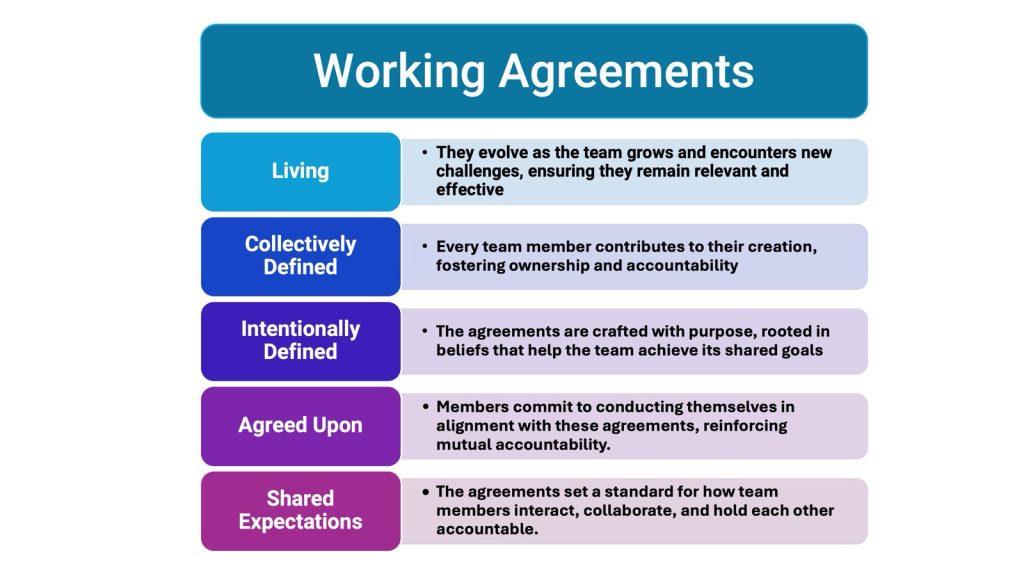
As I work with teams, I find myself increasingly curious about what makes some teams thrive while others struggle. More recently, I’ve become particularly interested in working agreements—the shared expectations that shape how teams collaborate. I believe many teams operate without them, and that taking the time to clarify how we work together can be a game changer for team effectiveness.
But is this simply intuition, or does research support it?
To explore this question, I turned to the work of Ruth Wageman and her colleagues, who studied what separates outstanding senior leadership teams from the rest. Their findings make a compelling case for the role of working agreements in team effectiveness.
Ruth Wageman and her colleagues conducted an extensive study of 120 senior leadership teams across 12 countries, spanning small businesses, multinational corporations, non-profit organisations and public-sector organisations. High-profile organisations such as IBM, Philips, Reuters and Shell participated in the research.
Their goal was to understand which team conditions led to measurable outcomes. They looked at whether teams met expectations, collaborated effectively, contributed to members’ learning and development, and improved over time.
From this research emerged the Six Conditions for Team Effectiveness.
Three essential conditions form the foundation of strong team performance:
- A Real Team – Clear boundaries and stable membership.
- The Right People – Knowledgeable, experienced and interdependent individuals.
- A Compelling Purpose – A clear, engaging reason for the team’s existence.
Three enabling conditions accelerate team effectiveness:
- A Solid Structure – Defined roles, tasks and team norms.
- A Supportive Organisational Context – Resources, incentives and a culture that enables success.
- Competent Team Coaching – Guidance that helps teams reflect, improve and stay aligned.
One factor emerged as the strongest predictor of an outstanding leadership team: team norms—the shared expectations about how members interact and work together.
“The presence of clear norms of conduct… had the largest impact of any sub-feature of the six conditions on whether a leadership team was effective.”
— Wageman et al.
In other words, teams that intentionally establish and uphold working agreements perform better.
The research suggests that strong working agreements create the conditions for trust, accountability and effective collaboration. Rather than leaving expectations to chance, high-performing teams take the time to make them explicit.
Working agreements may appear simple, but they are one of the most practical and influential levers available to leaders who want to improve how their teams work together.
Before looking for more sophisticated solutions to team performance, it may be worth asking a much simpler question:
Has your team ever intentionally agreed how you want to work together?