Do you remember ground rules?
Do you know what ground rules are? Those lists of expectations we set at the start of a workshop. I remember attending away-day sessions where the facilitator would start by asking “What do you need to have a productive conversation?” Each of us would say what we needed – like respect, being heard, regular breaks. Simply articulating these needs and hearing what mattered to others raised awareness for all and shifted the way we interacted. Once we left the conference venue and returned to the office the ground rules were forgotten.
Ground rules were effective in that facilitated session, but had limitations. They were often a collection of individual requirements rather than collectively defined and agreed-upon behaviours. They existed only for the session itself and did not carry through to day-to-day team interactions. While they set expectations, these expectations were not necessarily shared—often reflecting individual wishes rather than a true team agreement.
Working agreements are an improvement of ground rules. In this article, I will explore what working agreements are and provide a clear definition.
What is a team?
To begin to understand what working agreements are, we need to start by understanding what a team is. Kurt Lewin, pioneer in group dynamics, defined a team “not a mere collection of individuals but a dynamic whole, based on interdependence”. Ruth Wageman, a leading researcher on teams, defines a team as “interdependent for a shared purpose”.
The key characteristics of a team are interdependence and shared purpose. Interdependence speaks to each member having a piece of the puzzle and needing the others and shared purpose speaks to the idea that the team exists to achieve something together. Since teams rely on each other to achieve something together – then they need clear structured ways of working together to perform effectively. This is where working agreements play a vital role.
What are working agreements?
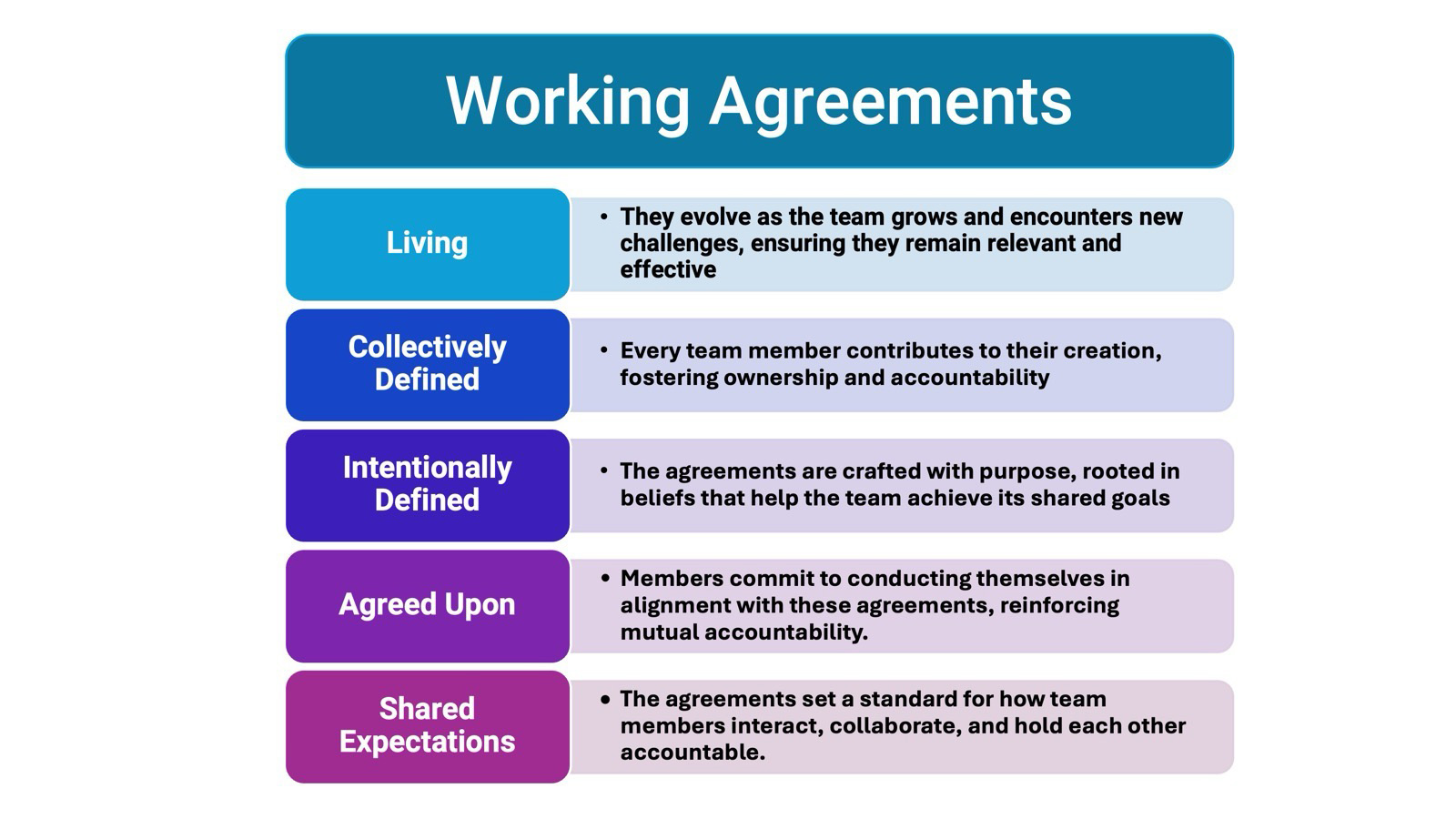
Working agreements are living, collectively and intentionally defined, and agreed-upon behaviours that set shared expectations for how members of an interdependent team conduct themselves to achieve shared success.
Breaking It Down:
- Living – They evolve as the team grows and encounters new challenges, ensuring they remain relevant and effective.
- Collectively Defined – Every team member contributes to their creation, fostering ownership and accountability.
- Intentionally Defined – The agreements are crafted with purpose, rooted in beliefs that help the team achieve its shared goals.
- Agreed-Upon Behaviors – Members commit to conducting themselves in alignment with these agreements, reinforcing mutual accountability.
- Shared Expectations – The agreements set a standard for how team members interact, collaborate, and hold each other accountable.
A working agreement is more than just a list of rules – it is a commitment to showing up in ways that enable team success. It is rooted in the belief that these behaviours not only drive collective achievement but challenge and stretch both the team and its members to grow. Working agreements don’t just enhance team effectiveness – they build the very competency required to perform effectively within a team.
How teams work together is just as important as what they work on. Too often teams focus only on tasks, deliverables, neglecting how they work together – yet collaboration is just as important as execution.
If teams truly depend on each other to achieve great results, shouldn’t they be just as intentional about how they work together as what they work on?
How intentional has your team designed the way you work together?
Image Credit : Be More Coaching Services